
How Many Professors Should You Email? Building a Smart Outreach List
Start with the email, not the number
The first email I sent to a professor took me four hours. I read three of her papers, wrote something specific about a method in the second one, rewrote the whole thing twice, and then stared at the send button for another twenty minutes. She never replied. The second one took me forty minutes and got me a fifteen-minute call that turned into my PhD offer. That gap (four hours of nothing, forty minutes of everything) is the real answer to how many professors you should email. It is not a count. It is a question about how many good emails you can actually write.
People want a number because a number feels like a plan. Email fifteen professors and you are done. But the count is downstream of everything that actually decides your outcome: whether the fit is real, whether the person is recruiting, whether your email sounds like it was written for them or for a list of two hundred. So before I give you numbers (and I will, with ranges, because anyone who hands you one exact figure is guessing), let me reframe what you are actually building.
You are building a portfolio, not hitting a quota
Think of it the way you would think about applying for jobs, except slower and with worse feedback. You are assembling a spread of genuinely good-fit professors across a sensible number of programs, and you are contacting each one as an individual. The spread matters because any single professor is a coin flip you do not control. The individual contact matters because the entire point of reaching out is that you are not a form in a stack.
A portfolio has a shape. Some picks are long shots you love. Some are strong, realistic matches. Some are safer bets where you would still be genuinely happy. You are not trying to maximize the raw number of emails you send. You are trying to maximize the chance that at least one excellent fit turns into a real conversation, and then an offer, without setting yourself on fire to get there. Everything below is about giving that spread a sane size.
Why one or two professors is a fragile plan
Cold academic emails have low reply rates, and the silence is noisy. A professor might not answer because she is on sabbatical, because she took two students last year and has no funding left, because your email landed in the worst week of grant season, because it got buried under ninety others, or because she genuinely is not a fit and did not feel like writing a rejection. You usually cannot tell which. From your side, a non-reply looks identical whether the reason is a hard no or a distracted "I forgot."
I will not hand you a fake statistic, because the honest truth is that reply rates swing wildly by field, by season, and by how targeted the email is. But plan around a reality where a good chunk of your messages get no response at all, some come back as a polite "I am not recruiting this year," and a smaller set turn into actual conversation. If your entire plan rests on one or two professors, you have built something a single sabbatical can knock over. That is not a fit problem or a talent problem. It is a sample-size problem. This is also why checking whether a professor is even accepting PhD students before you fall in love with the idea of their lab will save you a lot of quiet heartbreak.
Why blasting a huge identical list backfires
The opposite mistake feels productive and is quietly worse. You write one template, swap the name and the university, and fire it at eighty people over a weekend. It feels efficient. It is efficient at getting ignored. Professors read a lot of these, and a generic one is obvious inside two sentences: no reference to their real work, a research interest so broad it could be pasted under anyone, an "I am deeply passionate about your research" with no evidence you have read a single word of it.
There is a second cost that is easy to forget. People in the same subfield know each other. They sat on committees together, they review each other's papers, they were postdocs in the same lab. If you send Professor A an email that gushes about her work on one topic, and you send Professor B the identical email with that same topic still in it when B works on something else, and they compare notes (which happens), you look careless at best. I watched a friend torch two applications this way with one copy-paste error that named the wrong lab. Personalization is not a nicety here. It is the whole mechanism by which cold outreach works at all. The mechanics of writing a good one (what to say, how long, what to attach) I have written up separately in how to email a professor.
Okay, the actual numbers
Here is the part you scrolled for. I will give you ranges and the reasoning behind them, because the reasoning is what lets you adjust the numbers for your own case instead of copying mine.
Programs. Most applicants I know applied to somewhere around 6 to 12 programs. That range is not magic; it balances two real pressures. On one side, application fees run roughly 75 to 120 dollars each, plus transcripts and score reports, and it adds up fast. Twelve programs can quietly cost you well over a thousand dollars once everything clears. On the other side, too few programs is the fragility problem again. Six well-chosen programs where you are a strong fit beats twenty scattershot ones, but three is thin. If money is the real constraint, most departments have fee waivers and it is worth asking directly; nobody advertises them loudly.
Professors per program. In your materials (the statement, the "who would you want to work with" box some forms have), name 1 to 3 professors per program whose work genuinely lines up with yours. One can look narrow and risky if that person leaves or is not recruiting. Four starts to read like you are not sure what you want. Two or three is the sweet spot: it shows focus and gives the committee more than one reason to picture you in the department. Whether you actually email those professors before applying is a separate question that depends entirely on your field, which I will get to.
Across the whole cycle. Add it up and, for a lot of applicants, contacting somewhere in the range of 30 to 60 well-chosen professors over the season is reasonable. If you are in a very competitive field, or your profile is borderline and you are leaning on outreach to make your case, going higher (up to around 50 to 100) can make sense. But that ceiling comes with a hard condition attached, and I mean hard: every single email still has to be genuinely personal. The moment you cross from "a lot of real emails" into "a mail merge," more stops helping and starts hurting you, for the reasons in the section above.
Those ranges look wide because the honest answer is genuinely conditional. The right number for you depends on three things: how competitive your field is, how strong your profile looks on paper, and whether emailing professors is expected in your field and country at all. A strong applicant in a field where committees do the admitting might email almost no one and be fine. A borderline applicant in a system where you basically need a professor to champion you might write eighty careful emails and consider it time well spent. Same question, opposite answers, both correct.
The real limit is you, not a magic number
Notice what the ceiling actually is. It is not a figure a blog can hand you. It is how many genuinely personal, well-researched emails you can write before the quality slips or you burn out, whichever comes first, and it is usually burnout.
A real email means you read at least one or two of their recent papers closely enough to say something specific and true. It means you can name why your background connects to a project they are running now, not one they wrapped up in 2015. That is real work: maybe thirty to sixty minutes per professor once you are warmed up, more at the start. Fifty of those is not a weekend. It is a project. Try to do it in one caffeinated night and email number forty will read like a hostage note, and you will have wasted the effort on both ends. Quality per email beats raw count every time, and it is not close. Ten sharp, specific emails will do more for you than sixty limp ones.
Build the list by fit, not by ranking
When you build the list, sort by how well the research matches and whether the person is plausibly recruiting, not by where the university sits on some ranking table. That ranking is a weak proxy for what your actual life will be like for five or six years. Your advisor and your project are the thing that matters. A perfect-fit lab at a program ranked fortieth will make you a better researcher than a vague fit at the one ranked third, and it is not particularly close.
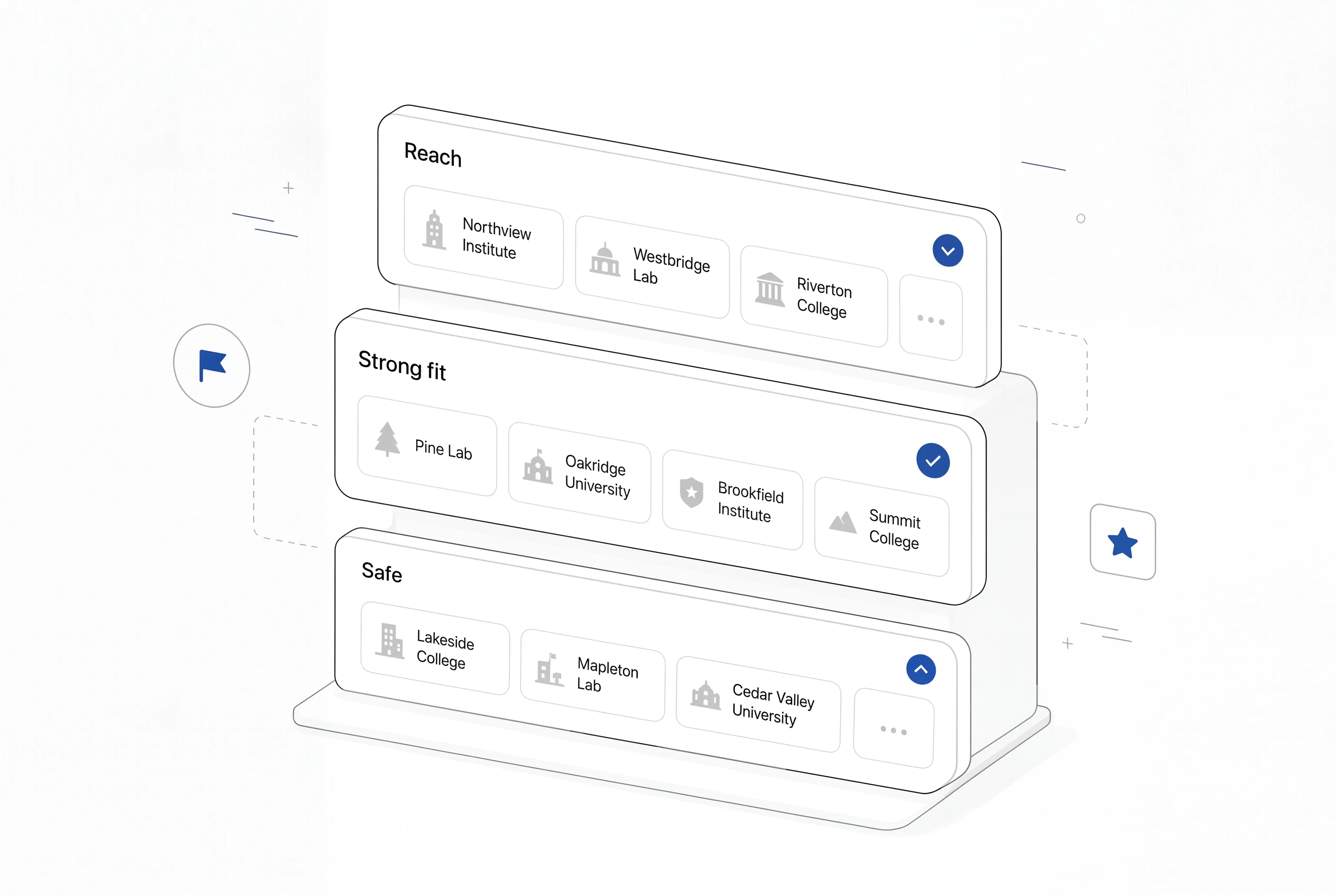
I sorted mine into three tiers, and it kept me honest about the difference between excited and realistic:
- Dream-fit. The match is almost uncanny (their open questions are your questions), but it is a long shot for reasons you can already see: a superstar advisor, a tiny lab, a brutal admit rate. Apply anyway. Just do not build your hopes on this row.
- Strong-fit. A genuinely great match where you are a realistic candidate. This is the heart of your list. Most of your best emails and most of your programs should live here.
- Solid-fit. A good, honest match somewhere your odds are more comfortable. Not a consolation prize: a place you would actually be happy to spend years. If the word "safety" makes you sloppy about fit, drop the word; there is no point applying anywhere you would not go.
Deciding which tier someone belongs in is really a judgment about research fit, and getting that judgment right is a skill on its own. I wrote a whole piece on how to match your interests to a lab's real work, because it is exactly where most people either over-count long shots or quietly miss the strong-fit people sitting right in front of them.
Your field decides how much of this you even do
This is the piece that generic advice skips, and it changes your numbers completely. Emailing professors is expected and often necessary in some fields and countries, and close to irrelevant in others.
In much of the United States (a lot of the sciences, and especially anything with committee-based admissions) you apply to the program, not to a professor. A committee reads your file, decides who gets in, and matches students to advisors later, sometimes after a year of rotations. In those programs a cold email is optional and sometimes politely ignored, because that professor does not individually control your admission. Reaching out can still help to confirm someone is taking students and to put your name in their memory, but it is not the control it feels like.
In computer science and much of engineering, and across most of Europe and the UK, it flips. There a specific professor usually has to want you: they hold the funding line, the project, the final say. A PhD position in Europe is often an advertised, funded job attached to one supervisor, and if you do not email that supervisor, you are not really applying. The same goes for many UK studentships. In those systems the professor is the front door, and skipping the email is skipping the application entirely.
So before you size any of this, find out which world you are in. Ask people one or two years ahead of you in your exact field, not a generic forum. Read the department pages: if they say "contact potential supervisors before applying," believe them. Getting this wrong in either direction wastes real effort: emailing eighty people in a committee-admissions field where it barely registers, or emailing no one in a system where the professor is the gate and silence means you never applied.
Track it like the small project it is
Once you are past a handful of professors, your memory will fail you, and a failure here is the embarrassing kind. You will email someone twice. You will forget who you promised to follow up with. You will blank on which paper you referenced when they reply three weeks later with a sharp question. A plain spreadsheet fixes all of it, and it does not need to be clever.
Mine had one row per professor and these columns: name, university, the specific paper or idea I referenced in the email, the date I sent it, reply status, and a follow-up date. That was the whole thing. The "specific paper I referenced" column did the most work: it meant that when someone replied, I could reload the exact context in ten seconds instead of frantically re-reading their site. The follow-up date meant I actually followed up once, politely, after a week or two of quiet, instead of either pestering people or letting warm leads die. Reply status kept me from the double-email humiliation. A boring tool with a large payoff.
Send in waves, not in one night
Do not send sixty emails on a Sunday. Send a first wave (say, eight to fifteen of your strongest-fit people) and then watch what happens. The replies teach you things no article can. Maybe your email runs too long; you will feel it when nobody bites. Maybe one particular sentence keeps drawing a response and you realize that is your real hook. Maybe someone writes back "not recruiting, but talk to my colleague," and your list suddenly grows in a direction you did not plan.
Then send the next wave with what you learned. This also spreads the emotional load, which is not a small thing over a three-month stretch. Sixty non-replies in one week will convince you that you are unwanted and unqualified. The same sixty spread across waves, salted with the occasional real conversation, read as what they are: normal. You stop when you have enough live conversations and strong applications in motion that adding more would only dilute the attention you are giving each one. That is the real stopping rule, not a count, but the moment you cannot give another email the care it needs. When you hit that point, you are done, whatever the number says.
Silence is not a verdict
Here is the part I wish someone had told me before I refreshed my inbox forty times a day. Low reply rates are the normal condition of this process, not a signal about your worth or your potential. A professor's silence almost always means "busy," or "not recruiting," or "your email arrived on a bad Tuesday." It very rarely means "you are not good enough," and even when it is a genuine no, it is a no about fit and timing and funding, not about you as a person or a scientist.
I press on this because the low base rate does something ugly to your head if you let it. You start reading rejection into arithmetic that was never about you. Ten silences in a row is a completely ordinary outcome that says nothing, and the eleventh email can be the one that works. Keep the numbers in perspective, and keep sending careful, specific, human messages to people whose work you actually admire. That is the whole method. The count is just bookkeeping.
The one thing that genuinely changed this for me was cutting the time each personal email took without making it any less personal, because the exhausting part is never the typing, it is the research: finding the right people, reading enough of their work to say something true, keeping the whole list straight. That is the narrow problem ApexApply is built for: it helps you assemble a fit-based list and drafts a grounded first version of each email from a professor's actual papers, so your energy goes into the judgment and the personal touch instead of the digging. Use it or do it by hand, either way the principle holds. A smaller set of genuinely personal emails, sent in waves to people who actually fit, will always beat a big list sent in one tired night.