
When Should You Start Contacting Professors? A PhD Outreach Timeline
The most common outreach mistake is not what you say in the email. It is when you send it. People email a professor sixteen months before they would start, in the wrong season, and get a warm but useless reply. Or they email three days before the deadline, when the professor has already had the conversations that quietly decide who gets in. Both are avoidable, and both come from not understanding the calendar the professor is actually on.
I went through a US application cycle and watched close friends apply across Europe and the UK at the same time, so I have seen the calm version and the panicked version up close. Here is when to actually reach out, and why the timing matters more than most guides admit.
The short answer
It depends on your field and your country. For a typical US PhD with deadlines around December 1 to January 15, the sweet spot for a first email is early to mid fall, September and October, of the year before you would enroll. So if you want to start in August or September of 2027, you are emailing in the fall of 2026, roughly two to three months before the applications are due.
Earlier than that, and the professor usually cannot tell you anything real about next year. Later than that, and you are one more message in an inbox that is already overflowing with applicants. The window is narrower than people expect, and it maps almost exactly onto how funding and recruiting work behind the scenes.
Why the window is so specific
Professors do not run on the applicant's clock. Their year is shaped by grant cycles, cohort planning, and teaching assignments. A professor you email in April, for a start date sixteen months away, often genuinely does not know yet whether they will have money or a slot for a new student. Grant decisions land, renewals come through, a new hire's startup package gets finalized, the department allocates its teaching-assistant lines, and a lot of that settles over the summer and into early fall.
By September and October, most professors have a rough sense of whether they can take someone next year. By late November they are grading, writing their own grant reports, and the conversations with the admissions committee about the incoming class are mostly framed. That is the mechanical reason early fall works. You are reaching them in the short stretch when they know something concrete and still have room to think about you.
Here is what a too-early email actually gets you, from watching it happen to friends and to me: a friendly two-line reply that says some version of "this is a bit early, but please do apply and mention your interest in my work." It is not a rejection. It is also not information. You cannot tell whether they will have funding, whether they are taking students, or whether they will even remember you in six months. You have spent one of your best specific emails on a moment when the professor had nothing to offer back. Sent in the fall, that same email can get you a real answer.
Field matters here too. In lab sciences, engineering, and computer science, a specific advisor often funds you off their grants and has to actually want you in the group, so a well-timed email can carry real weight. In much of the humanities and parts of the social sciences, admissions run through a committee, money comes from the department or from fellowships, and a single professor cannot admit you on their own. There a cold email matters less, and in a few departments it is quietly discouraged. Before you obsess over timing, find out which of these worlds you are applying into. The single fact that reshapes your whole plan is whether a given professor is actually taking students this cycle, and it is worth checking early.
The month-by-month timeline (US fall deadlines)
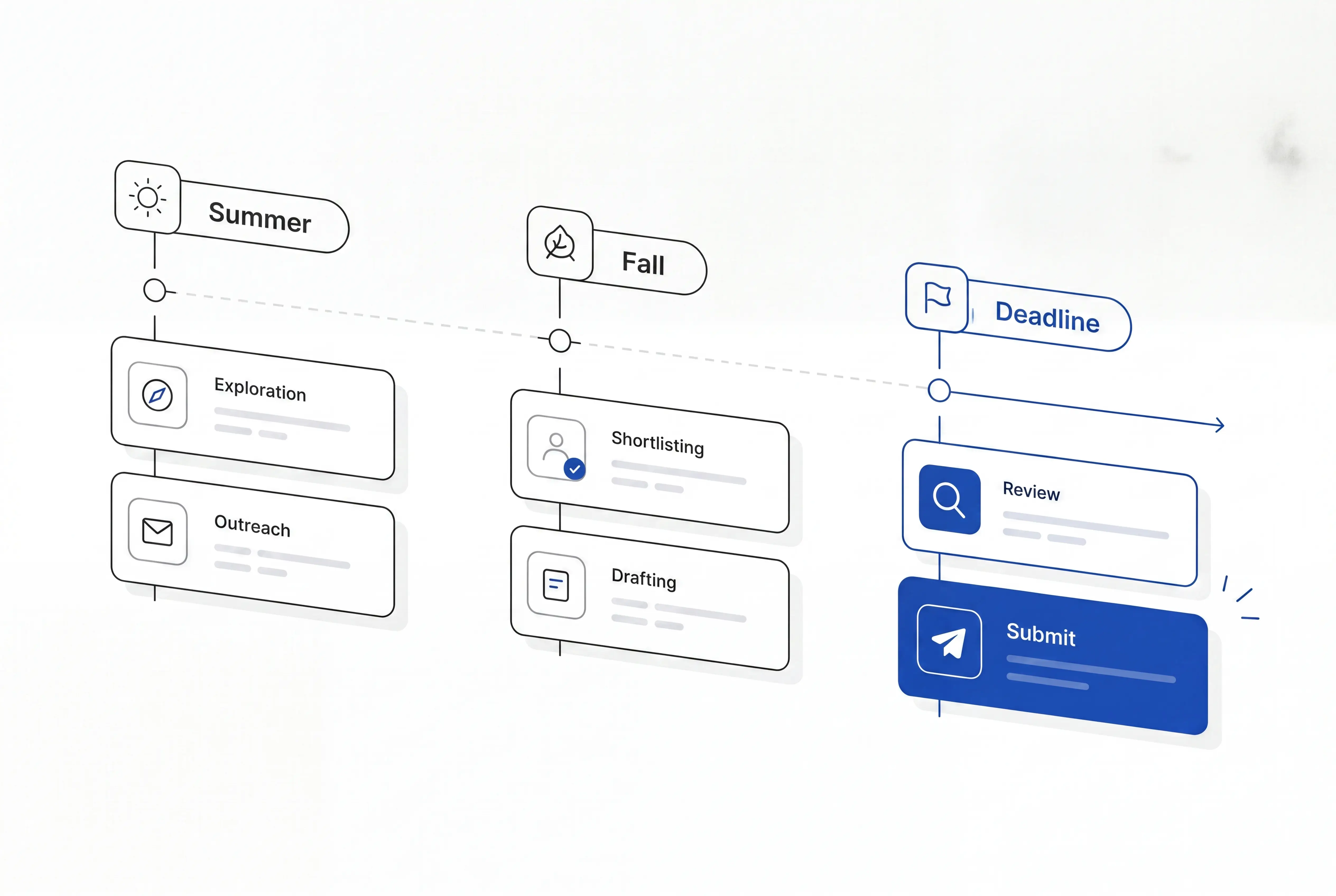
Here is the same cycle laid out as a calendar. The dates assume deadlines clustered around December 1 to January 15 and a start the following late summer. Shift everything a few weeks if your programs run earlier or later.
- Spring to summer, twelve to eighteen months before deadlines. This is groundwork, not outreach. Work out what you actually want to research, not just the broad area, since "I am interested in machine learning" is not something a professor can respond to. Read enough to build a map of the field and a long list of people whose work you would be glad to spend five years near. Start thinking about who will write your recommendation letters. If your programs need the GRE or an English test, study now, while nothing else is due. Do not email anyone yet. This is also when the slow work of finding an advisor whose interests fit yours pays off, and it is a good use of a stretch when there is otherwise little to do.
- The summer right before, June to August. Cut the long list down to a shortlist. Read your top people's last two or three years of papers closely, not just the abstracts, because that reading is exactly what makes a later email worth answering. Draft your CV and a first version of your statement. Decide which programs you are applying to and which professors you would write to at each one.
- Early fall, September to October. Send the emails. This is the window. Keep each one short, specific, and clearly written for that one person: reference the actual work, say what you would want to do, ask a real question. The mechanics of writing that first email deserve their own attention, because a generic template sent at the perfect time still lands like a generic template.
- Late fall, October to November. Finish the applications. Send any outreach you did not get to, plus one polite follow-up to people who did not reply. One, not three. Formally ask your recommenders now if you have not, and hand them your materials and a clear deadline with about six weeks of runway, because a rushed letter reads like a rushed letter.
- December to January. Submit. Check each program's exact deadline and fee, and give yourself a couple of days of buffer, because portals get slow and something always breaks the night before the cutoff.
- January to March. Interviews and visit days, in the fields that do them. Some programs fly you out or run virtual interview weekends; others simply send decisions. If you interview, this is where the fall emails quietly pay off, because a professor who already knows your name reads you differently in the room.
- Late March into April. Offers, and the actual decision. Which brings up the one date every US applicant should understand.
What April 15 means for you
April 15 is the traditional reply-by date in US PhD admissions. For years it was formalized by a national agreement among graduate schools: a program offering you financial support could not require you to commit before April 15, which gave applicants time to hear back from everyone and compare funded offers instead of being rushed into the first one. The formal version of that agreement has shifted in recent years, so do not treat it as an ironclad law, but mid-April is still the common decision deadline at most programs, and the spirit of it holds.
What it means for you, in practice: if a program makes you a funded offer in February and pushes you to decide within a week, you can almost always ask for time, and you are usually within your rights to wait. Do not let one eager program stampede you into committing before you have heard from the others. Read the actual offer letter for the date it names. And if you accept one offer and a better one arrives, the honest move is to formally withdraw from the first before you say yes to the second. People in a field remember how you handled that.
Europe, the UK, and position-based systems
Outside the US committee model, a lot of PhD admission is tied to a specific funded position or project, and the timing is rolling rather than a single fall deadline. A professor or lab advertises a funded PhD post, often attached to a particular grant, and you apply to that post. When the position is open is when you contact them. Miss it by two months and there is nothing to apply to. Show up a year early and there is nothing there yet.
A few concrete patterns. In much of continental Europe, a PhD is a paid job, and posts appear year-round on university and lab pages, on the ERC-funded projects of individual professors, and through national schemes. You email when a relevant post is live, or a few months before an intended start if you are asking about upcoming funding. In the UK, you often need to identify and contact a potential supervisor before or during the application, because you are applying to work with a specific person, and many funded studentships run on their own annual cycles with deadlines that can fall anywhere from autumn to spring depending on the scholarship. The big national and university doctoral funding competitions in particular tend to close earlier than you would guess, sometimes deep in the winter for an autumn start, so check each one by name rather than assuming.
Not all of Europe is rolling, to be fair. Some countries and universities have moved to structured doctoral programs and graduate schools with fixed annual deadlines that look a lot more like the US model, and some large fellowships have a single yearly cutoff. The safe habit is to treat every program and every funding source as its own case: find the specific deadline, find out whether it expects you to have a supervisor lined up first, and work backward from there. The cost of a wrong assumption is high in these systems, because a missed funding deadline can mean the position exists but there is no way to pay you for it.
The rule of thumb that travels across all of these: reach out roughly six to twelve months before you would start, anchored to when the funding or the position is announced rather than to a fixed calendar month. And because these systems lean so heavily on the individual supervisor, the email itself matters more here than almost anywhere in the US model.
Master's programs run on a different clock
If you are applying to a coursework master's, most of this timing advice loosens. Admission is usually decided at the program level, not by an individual professor, and there is often no one to email in the sense that PhD applicants mean. The runway is shorter too. You can go from decision to submission inside a single fall, and rolling admission at some programs means earlier is simply better for your odds and for any funding on offer.
Reaching out still helps in one case: a research-heavy or thesis master's where you will work in a specific lab or with a specific advisor. There the same logic as a PhD applies, just on a compressed schedule. Email in early fall, be specific about the work, and ask directly whether they take master's students into their group. For a taught master's with no research component, put your energy into the application itself rather than into emails most professors are not expecting and will not weigh.
If it is already November and you have not emailed anyone
First, apply anyway. Late outreach beats no outreach, and plenty of people get in without ever sending a single email, especially in committee-run fields. You have not missed the deadline that actually decides whether you are considered, which is the only one that is non-negotiable.
Then triage. Do not try to email thirty people in a week, because you will write thirty forgettable emails. Pick a short list of the best-fit professors and write each of them one tight, genuinely personalized message now. Quality over volume is always the right call, and it matters even more under time pressure, so it helps to be honest with yourself about how many professors are actually worth contacting instead of blasting the whole department. Keep each message short, reference their recent work specifically, and say plainly that you are applying this cycle. Some of them will still reply, and even a brief exchange before the committee meets can put a face to your file.
There is one more option worth sitting with honestly: waiting a year. If your application would be meaningfully stronger with another cycle, whether that means a finished thesis, a publication, a year in a lab, a better test score, or simply the months to do the outreach properly, then waiting is not a failure. It is a real strategic choice, and admissions committees do not hold a gap year against you. Do not wait out of panic, and do not wait if this cycle is honestly your best shot. But if November has arrived and you are nowhere close to ready, a deliberate extra year usually beats a set of half-formed applications you send in a rush and regret in March.
Plans slip, and that is fine
Everything above is a guide, not a rulebook. Real cycles are messier than any calendar. You will stumble onto a professor in October whose work is perfect and email them anyway, out of sequence, and it will be fine. You will start late one year and early the next. A recommender will go quiet and you will be chasing them in December. The timeline exists to keep you away from the two expensive timing errors, a year too early or a week too late, not to make you feel behind if your particular fall does not match the chart.
The part that genuinely rewards starting early is the least glamorous part: knowing the field well enough to write emails that sound like you actually read the work. That is the reading and shortlisting you do in spring and summer, and it is where a tool like ApexApply can save you real weeks. It helps you build and pressure-test a shortlist of well-matched professors quickly, so that when the fall window opens you are spending it writing good, specific emails instead of still hunting for names. Do that groundwork early, and the rest of the timeline mostly takes care of itself.